
Q3 2026 Retail Report
Beyond the headlines surrounding business exits, there remains a pipeline of new entrants, expanding brands and retail destinations being rejuvenated. Owners of newly acquired malls and existing landlords are investing in opportunities to reposition and future-proof retail destinations with greater innovation catered to changing consumer preferences
19 October 2026

Snapshot
- Prime Retail Rent
- Orchard: S$32.10 psf pm
- Suburban: S$28.00 psf pm
- Upcoming Supply (Q3 2026 to 2030):8 million sf GFA
Sustained visitor demand continued to support retail performance
- International visitor arrivals (IVAs) to Singapore totalled 4.5 million in Q3 2026, improving from 3.8 million in Q2 2026, and largely similar in the same period a year ago. The increase in IVAs from Q2 to Q3 may be attributed to seasonal travel demand during the summer holiday period across key source markets, alongside sustained business and MICE activity, as well as a steady pipeline of tourism and lifestyle events.
- The island-wide average gross rent for prime retail space continued to edge up slightly by 0.7% q-o-q to S$29.20 psf pm in Q3 2026 (Exhibit 1), bringing the growth in the first nine months of 2026 to 2.5%. Notably, prime retail rents rose across all localities for six consecutive quarters since Q2 2025, reflecting sustained occupier demand despite persistent operating challenges. The continued rental growth also signals confidence in the longer-term prospects of Singapore's retail market, encouraging landlords to reinvest in and reposition their assets.
Retail sales performance
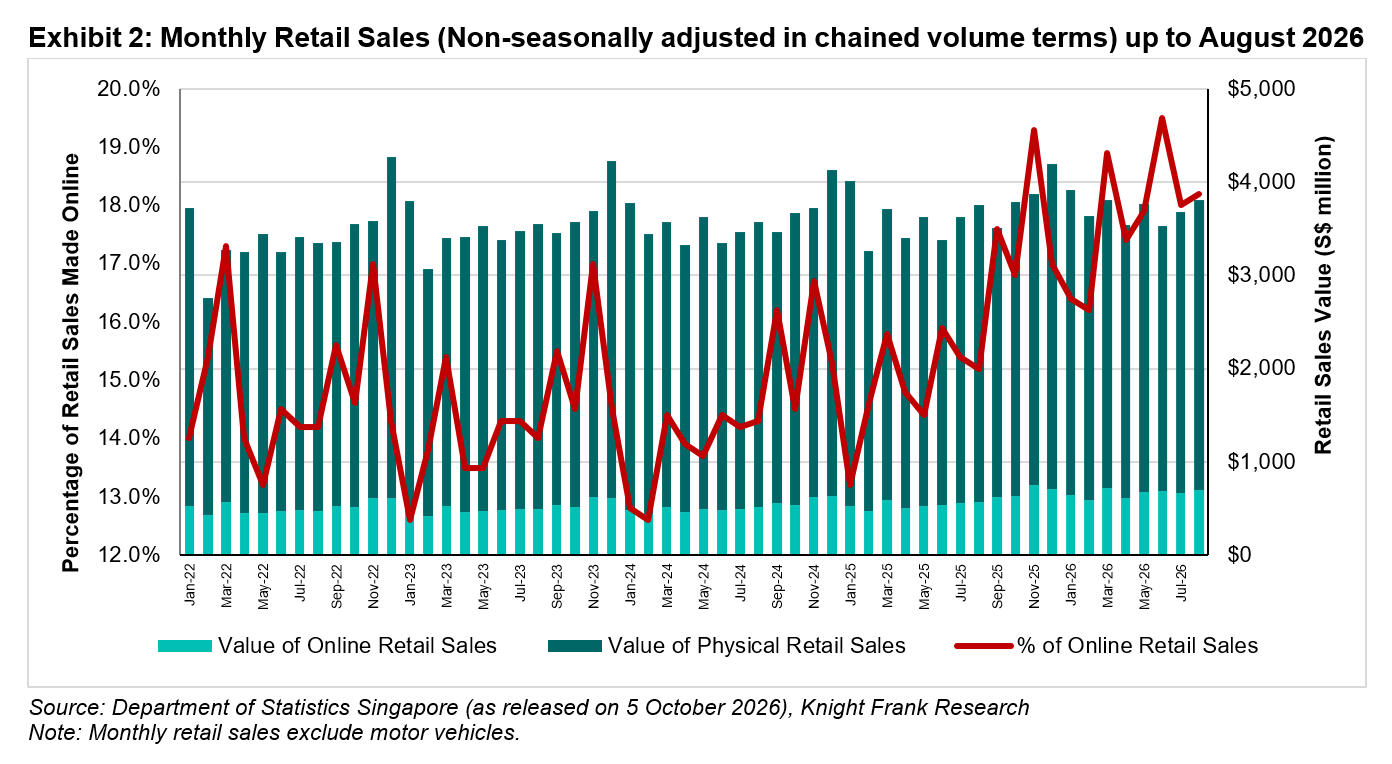
- Retail sales (excluding motor vehicles) for July and August 2026 totalled S$7.5 billion, more than the combined S$7.3 billion recorded in April and May 2026, as well as the same period a year ago (Exhibit 2).
Reimagining retail for long-term relevance
- The challenges in the retail sector have regularly been in headlines in the past few years, especially where new brands as well as household names have exited the market citing untenable operational cost pressures. In the first nine months of 2026, there were 7,587 business cessations from the retail trade and F&B services sectors, about 8% more than the 7,027 in the same period a year ago. Despite the attrition, the sector remained firmly on the path of growth as retail and F&B business formations from January to September 2026 grew 15.5% to 10,175 from the 8,808 in the same nine-month stretch a year ago. This translated into a net increase of 2,588 in the three quarters of 2026, outpacing the net increase of 1,781 in the same 2025 period. For every closure, the reality remains that more shops and eateries are opening, quickly replacing former occupiers and filling up vacant spaces, especially in popular mall destinations.
- And it is against this backdrop that there has been a wave of retail asset acquisitions by investors willing to pay-to-play in the shopping centre arena. Major deals with a substantial retail component included Paragon, Wheelock Place, White Sands, Bukit Panjang Plaza, i12 Katong, Scotts Square retail podium, Rivervale Mall and others changing hands in 2026. This activity over the past year could set the stage for more asset enhancement initiatives (AEIs) and redevelopment projects across Singapore's retail landscape. With existing rejuvenations such as Plaza Singapura's progressive AEI works, as well as Marina Square and Harbourfront Centre's redevelopment, landlords are increasingly looking to reimagine how retail assets can remain relevant in a rapidly changing market. It is expected that several, if not most, of the newly acquired retail assets in the hands of new owners will also be refreshed. As consumer expectations evolve, these initiatives present opportunities to reshape tenant mixes, introduce fresh concepts, and create more distinctive retail destinations that stand out in an increasingly crowded space.
- The call for retail transformation could and should also extend beyond privately owned malls. As new housing estates mature and a new generation of homeowners collect the keys to their homes, town centres will increasingly be expected to keep pace with evolving lifestyles and consumption habits. Future retail offerings in developing residential neighbourhood hubs would need to go beyond daily sundry convenience to support how residents live, work and spend their leisure time at community centric destinations.
Market outlook
- Despite healthy visitor arrivals and a retail leasing market where new openings continue to outpace exits, operating conditions remain uneven across a sector that will continue to be characterised by attrition. Businesses are still contending with elevated manpower and occupancy costs, while increasing adoption of artificial intelligence in certain industries and reports of workforce rationalisation may temper consumer confidence. Against an employment backdrop that is growing less certain, households could become increasingly selective in their spending, prioritising value and necessities over discretionary purchases. This might result in greater divergence in performance, with experiential, necessity-driven and value-oriented concepts proving more resilient than retailers reliant on aspirational or discretionary demand.
- Even so, the outlook for the final quarter of 2026 remains cautiously positive. IVAs are expected to provide an important buffer against the possibility of softer local demand, supported by marquee events such as the Formula 1 Singapore Grand Prix and a packed year-end calendar of leisure, entertainment and festive activities. Retailers are also becoming more sophisticated in blending physical and digital channels, while consumers continue to place a premium on experiences, convenience and brand engagement. These trends should help sustain footfall and spending, particularly in prime retail precincts and destination malls.
- Looking ahead, leasing momentum is expected to remain moderately buoyant, albeit measured. Demand is likely to be concentrated among occupiers seeking high-quality assets with strong catchment demographics, tourism exposure and experiential offerings that cannot be easily replicated online. While retailers are expected to remain disciplined in expansion decisions, the relative scarcity of prime space and continued appetite from new-to-market and expanding brands should provide support for rents. Consequently, prime retail rents are projected to remain on a modest growth trajectory, rising by approximately 3% for the whole of 2026, placing performance near the midpoint of Knight Frank's original forecast range of 2% to 4%.