
Q3 2026 Residential Report
While the residential market remains resilient due to healthy liquidity and strong household wealth, indications of higher interest rates and rising land costs at government tenders have introduced the spectre of upcoming uncertainty. This could spur buyers into action sooner-rather-than-later
15 October 2026

Non-landed Private Residential Property Price Index (Flash Estimate)
212.5 (Q3 2026**)
0.9% q-o-q increase
1.9% y-o-y increase
Total Non-Landed Transaction Volume excluding ECs
4,229 units (Q3 2026*)
22.8% q-o-q decrease
38.1% y-o-y decrease
URA flash estimates
- Flash estimates released by the Urban Redevelopment Authority (URA) showed that prices of non-landed private homes (excluding Executive Condominiums (ECs)) grew 0.9% q-o-q in Q3 2026**. Private non-landed home prices in the Rest of Central Region (RCR) and Outside Central Region (OCR) increased 0.2% q-o-q and 2.2% q-o-q respectively, but home prices in the Core Central Region (CCR) declined 0.1% q-o-q. This was reflective of an uneven three months with limited launches due to the Chinese Seventh Month.
- In the third quarter of 2026, sales activity of non-landed homes dropped 22.8% q-o-q to record a total of 4,229*. The five new projects launched during the quarter did not churn as many sales as those introduced in the first half of the year, and primary sales fell to 1,145 units, decreasing 45.9% q-o-q from 2,115 units in Q2 2026. Likewise, the number of secondary transactions fell by 8.3% q-o-q* to 3,084 units in Q3 2026 (Exhibit 1) as the growing number of retrenchments amid the AI revolution increased job security fears, notwithstanding the current low unemployment rates.
Core Central Region (CCR)
- Sales activity grew slightly with the two new CCR projects launched in Q3 2026, , namely Dunearn House in July, and Amberwood at Holland in September. Dunearn House sold 56% of its units at an average of S$3,140 psf, and Amberwood at Holland sold 11% in its first phase of sales at an average price of S$3,019 psf. Demand for the new launches translated to an uptick in new sale transactions, and the total sales volume of non-landed homes in the region increased 18.0% q-o-q to a total of 832 units* transacted in Q3 2026.
- Despite the pickup in sales activity in the CCR, home prices remained relatively stable, falling very marginally by a mere 0.1% q-o-q**. Prices of the newly launched projects during the quarter generally matched existing benchmarks in the CCR, with demand coming from younger buyers preferring to live closer to their parents currently residing in the nearby mature estates, as well as other Singapore resident buyers who continue to believe in the long-term value of such properties.
Rest of Central Region (RCR)
- In tandem with the slower overall sales activity islandwide, private home sales in the RCR fell to a total of 1,371 units*, reflecting a quarterly decrease of 16.0% in the third quarter of 2026. With no new launches in this market segment, new sales fell 32.6% q-o-q to 372 units* through the sales activity of previously launched projects. Secondary sales declined 7.5% q-o-q to a total of 999 units* in Q3 2026.
- Home prices in the RCR remained stable with a quarterly increase of 0.2% q-o-q**. With no new developments introduced to reset market pricing benchmarks and existing secondary market transactions exerting downward pressure, price growth softened during the quarter.
Outside Central Region (OCR)
- The greatest number of units sold in Q3 2026 was in the OCR with a total of 2,026 units*, in both new sales and resale segments. New sales decreased 68.2% q-o-q to 476 units in Q3 2026 from 1,495 units in the previous quarter. The sole new project launched during the quarter was Lentor Gardens Residences. Launched in July, 54% of its project total number of units sold at an average price of S$2,350 psf during the launch weekend. Secondary sales in the OCR decreased 5.9% q-o-q to 1,550 units*.
- Notwithstanding the slowdown in sales activity, prices in the OCR rose the most compared to the other market segments, going up 2.2% q-o-q**, as demand for private homes remained resilient.
Rental movement
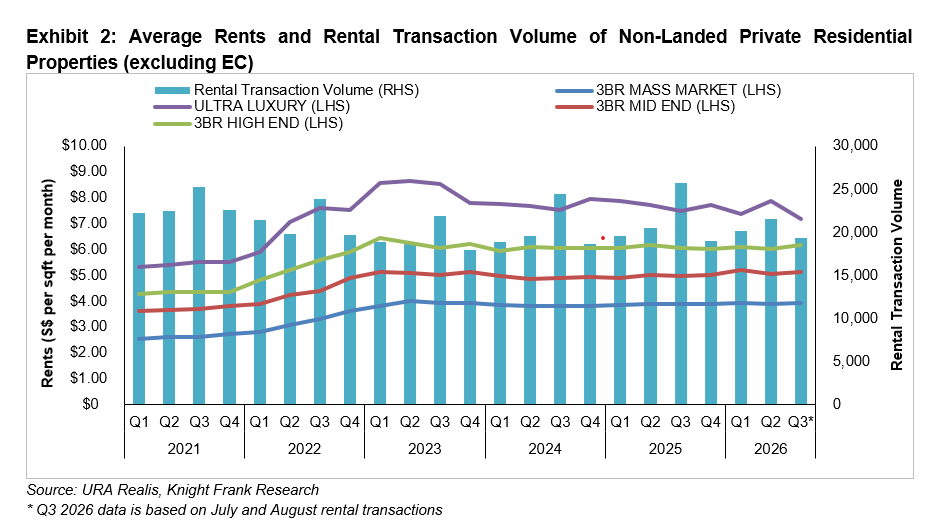
- In contrast to the slowdown in sales activity, rental activity grew. The total number of rental transactions recorded in July and August rose 41.1% q-o-q to 19,331 leases (Exhibit 2). Similarly, rents across market segments also increased at least 1.6% q-o-q, with the exception for the ultra-luxury market segment which fell 8.6% q-o-q.
Market outlook
- Singapore's private residential market has been resilient through 2026, supported by healthy household balance sheets, accumulated wealth and confidence in the city-state's long-term prospects. However, the outlook is becoming hazy. The US Federal Reserve's latest interest rate hike has introduced concerns that borrowing costs will increase in the months and year ahead. And even though unemployment levels remain low, retrenchments increased from 3,830 in Q1 2026 to 4,620 in Q2 2026, with layoffs concentrated in sectors such as manufacturing, information and communications, and financial services. Although the rapid advancement of artificial intelligence (AI) continues to power Singapore’s manufacturing sector and create substantial uplift in the economy, this is also paradoxically causing uncertainty to creep into the labour market due to the proliferation of AI-related disruptors across a widening range of occupations. These risks could temper purchasing sentiment as prospective buyers become more cautious about taking on long-term mortgage commitments.
- In conjunction with affordability pressures, land rates at government land sales (GLS) tenders have been increasing as top bids become more bullish. The average land rate for non-landed residential GLS sites increased about 21% during the 12-month period from Q4 2025 to Q3 2026 when compared against the duration between Q4 2024 and Q3 2025. While this reflects continued confidence in Singapore's long-term housing demand vis-à-vis the scarcity of quality development opportunities, higher land costs translate into higher future launch prices.
- Against this backdrop, potential buyers face the dual challenge of rising housing prices amid a more uncertain financing environment. The prospect of higher interest rates and launch prices in the future could encourage some buyers to advance their purchasing decisions to the next few months. As land costs rise, homebuyers may increasingly view projects launched in 2026 as offering relative value compared to future launches that will be developed on more costly land parcels. This demand would not be driven by fears of missing out on further price increases, but by a desire to secure housing before affordability deteriorates.
- The residential market's underlying fundamentals remain intact, but as interest rate risks, AI-related employment uncertainty and affordability pressures converge, outlook visibility is becoming obscured. The market remains resilient, though the horizon ahead appears decidedly hazier than it did a year ago.
* Based on data available as at 13 October 2026. Figures exclude Executive Condominiums (ECs).
** Based on flash estimates announced on 1 October 2026.